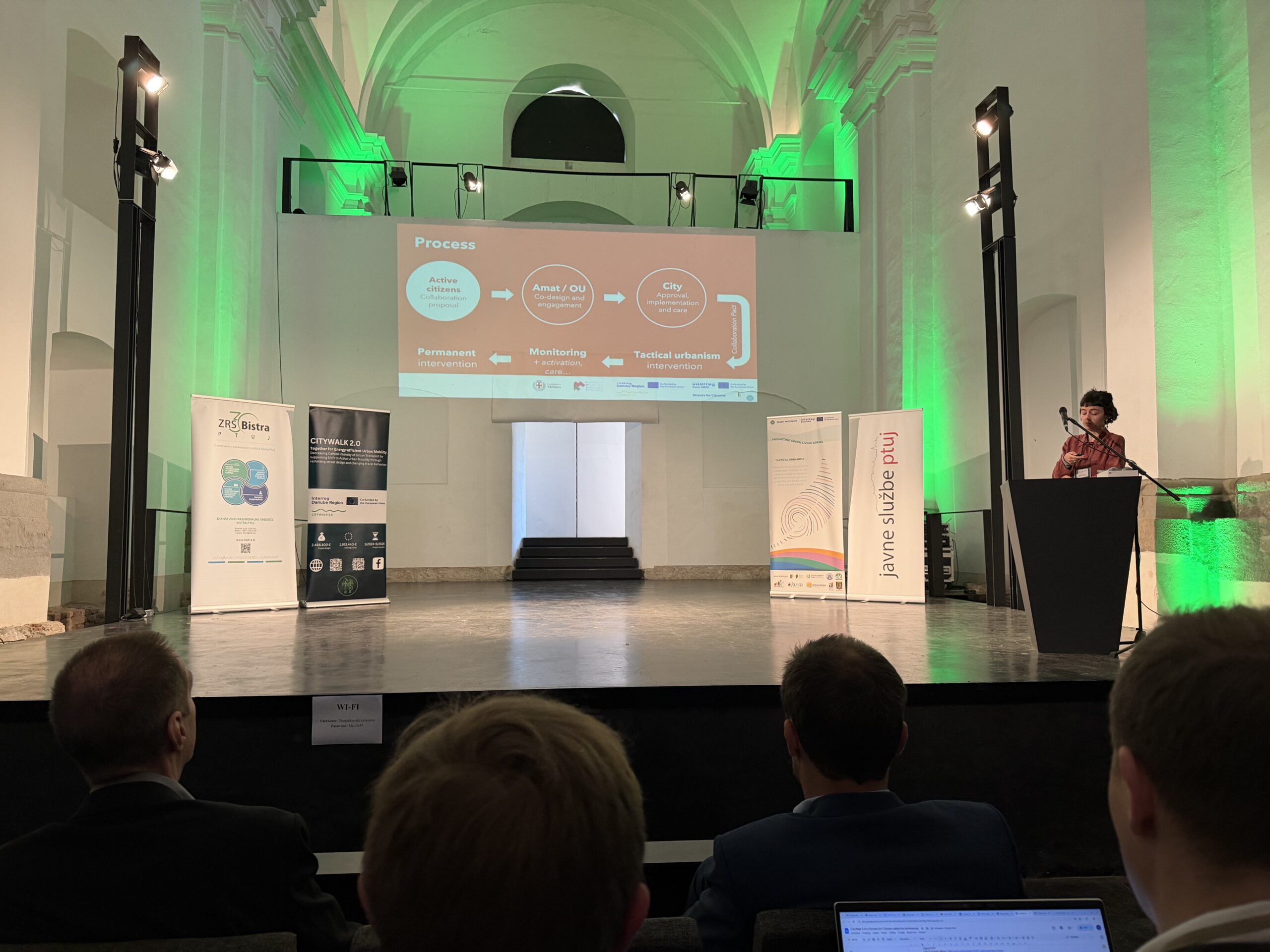
The keynote presentation was delivered by Beatrice Barone from AMAT in Milan, who presented the Piazze Aperte programme and the City of Milan’s experience with tactical urbanism.
According to Barone, tactical urbanism is not a specific tool or method but rather a process of experimentation in public space. The purpose of such interventions is to test solutions in real-life environments, observe users’ reactions, and gradually develop more permanent urban design solutions.
The Piazze Aperte programme was launched in 2019 as a pilot project through a partnership between the City of Milan, AMAT, and the Bloomberg Philanthropies. Its main objectives were:
- to rethink the role of streets and squares within neighbourhoods,
- to improve pedestrian and cyclist safety,
- to create higher-quality public spaces through low-cost interventions.
One particularly interesting insight was that Milan initially focused primarily on streets rather than squares. Redeveloping squares requires significantly more administrative procedures and permits, whereas street interventions can be implemented more quickly and at lower cost.
Among the most recognisable elements of the programme are colourful pavement paintings, movable urban furniture, plant containers, play elements, and temporary gathering spaces. Barone explained that the extensive use of colour was introduced after observing that people initially did not use newly reclaimed spaces, even when they had been physically separated from traffic. Once the surfaces were painted, residents began to perceive them as public spaces and used them much more frequently.
A key feature of the programme is citizen participation. The process generally begins with residents proposing a location. AMAT then assesses its feasibility, followed by a co-design process. The city subsequently makes a decision and establishes an agreement with the local community regarding cooperation and stewardship of the space. Barone noted that residents often do not possess all the necessary technical and transport-planning expertise, so professionals adapt their proposals to achieve the intended outcomes in an appropriate and technically sound manner.
A particularly engaging part of the presentation focused on school streets. The Piazze Aperte per ogni scuola programme applies the same principles as the broader initiative but is specifically tailored to the needs of children and schools. Barone emphasised a statement that became one of the central messages of the conference:
“Children represent 15% of our society, but 100% of our future.”
The example of Via Corridoni demonstrated the importance of communication, participation, and political support. During the planning process, conflicts emerged among different groups of residents. However, through a professional approach and open dialogue, the municipality succeeded in reaching consensus and gradually closing three streets to motorised traffic.
Barone concluded with reflections on the programme’s long-term development. Although many interventions remain temporary, tactical urbanism has proven highly effective in creating communities around projects—something often more difficult to achieve through conventional infrastructure investments. Monitoring impacts, collecting data, and gradually transitioning from temporary to permanent solutions are also essential elements of the process.