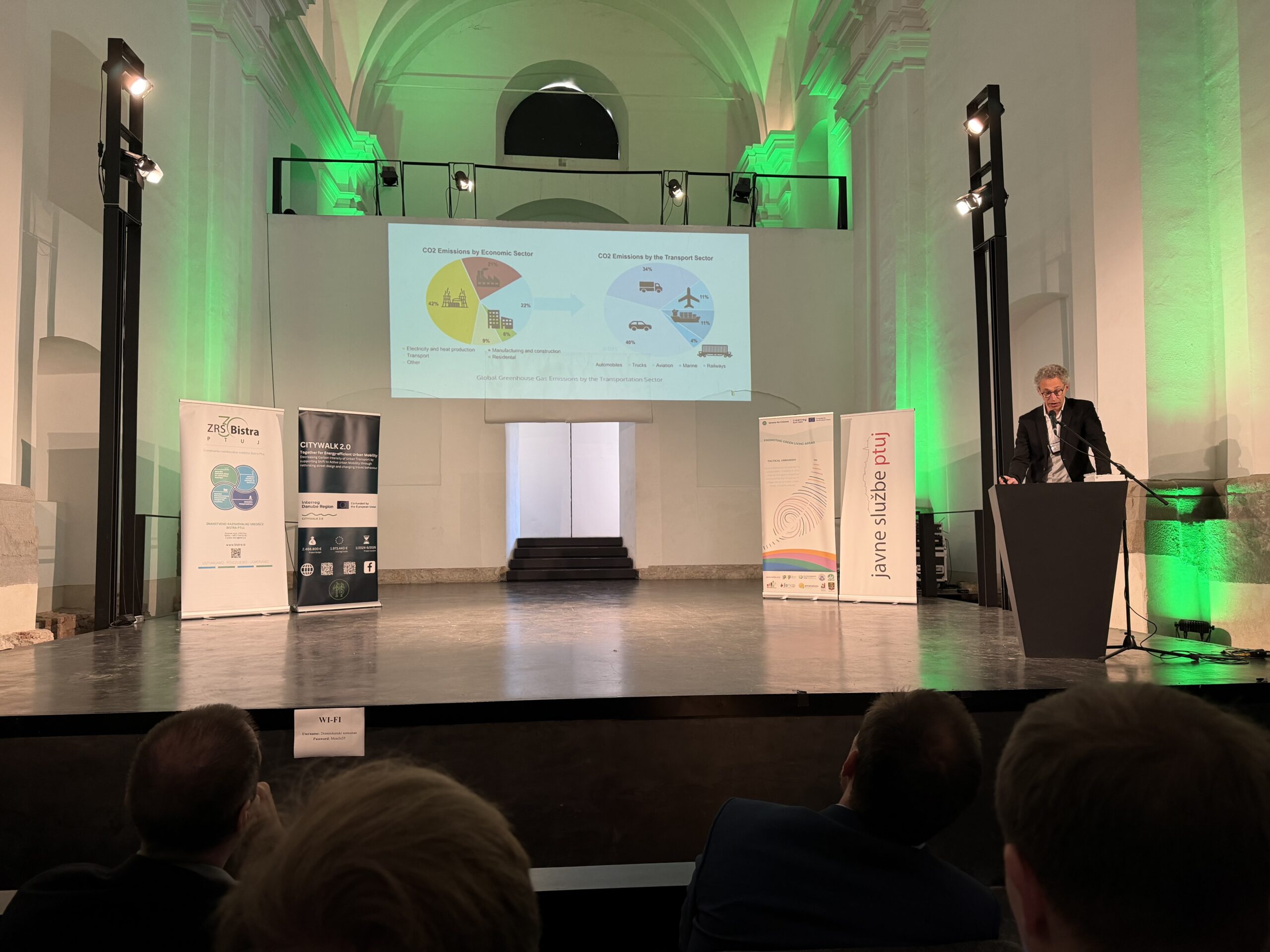
The second keynote presentation was delivered by Andreas Friedwagner from the Austrian consultancy Verracon, who presented the results of the Active2Public Transport (A2PT) project. His presentation focused on integrating walking, cycling, and public transport as the foundation of sustainable mobility.
He highlighted that European cities remain heavily dependent on private cars, even though cars occupy more urban space than any other mode of transport. Achieving European climate objectives therefore requires adherence to the “Avoid – Shift – Improve” principle: reducing the need for travel, shifting journeys towards sustainable transport modes, and improving existing transport systems.
One of the project’s key findings is that there is no public transport without walking. Every bus or train journey begins and ends on foot. Yet public transport operators often focus primarily on stations and vehicles, paying far less attention to the quality of the routes leading to stations.
Research presented during the lecture showed that access routes account for approximately half of total public transport travel time while shaping as much as 60–70% of the overall user experience. Consequently, even small improvements to pedestrian connections can significantly increase people’s willingness to use public transport.
Friedwagner emphasised the importance of high-quality pedestrian infrastructure and convenient bicycle access. In particular, he noted that bicycle parking should be located directly next to stations—or no more than approximately 100 metres away—otherwise usage drops considerably.
Another interesting concept presented was the idea of a station’s “attractive catchment area.” The distance people are generally willing to walk to a station is around 300 metres. However, if the route is safe, pleasant, and engaging, the effective catchment area can increase by as much as three times.
Examples from Austria and other Danube-region countries demonstrated how temporary interventions—such as pavement markings, planters, and minor street redesigns—were used to test improvements to public spaces. One particularly interesting case came from a small town in the Austrian state of Burgenland, where residents initially opposed proposed changes. Following measurements and temporary interventions, however, public opinion gradually shifted in favour of more ambitious transport measures, including the introduction of one-way streets.
An important component of the project involved so-called “test activities,” during which residents were encouraged for several weeks to use bicycles and public transport instead of private cars. The results demonstrated that personal experience can play a crucial role in changing travel behaviour. Some participants even purchased bicycles after the project ended and permanently altered their daily travel routines.